Saturday, July 28, 2018

Computing the Price Elasticity of Demand

                                      Price Elasticity of Demand
Change in the quantity demand of a product due to the change in its price is known as the elasticity of demand.
      Demand for a good is said to be elastic if the quantity demanded response more to slight changes in price and if the demand is said to be inelastic if the quantity demanded responds only slightly to changes in the price.

Computing the Price Elasticity of Demand
Price elasticity of demand is calculated by dividing the percentage change in quantity demanded by the percentage change in price.

For example, there is a 10% increase in the price of an ice cream cause the amount of ice cream you by to fall by 30%.

Price elasticity of demand= 30/10
                 
  Elasticity of demand           = 3

The state of Balance

The term equilibrium is derived from Latin word called "acqui" and "libra".Acqui means equal and libra means to balance .
Therefore equilibrium means equal balance .The dictionary defines the word equilibrium as a situation in which various forces are in balance and this also describe a market equilibrium .In physics the equilibrium refers to the state of balance . In lucid word equilibrium is a position in which no further change is possible .
                    There is one point called market equilibrium . At equilibrium price the quantity supplied equals the quantity demanded .At equilibrium price the amount of goods that buyers desire to buy is exactly balances the amount that seller desire to sell .It is sometimes called market clearing price as at this price everybody in the market has been satisfied

Do the demand on the product changes only because of price?

Demand curve is nothing but a graph between price and quantity. The quantity demanded is the willingness of the buyers to get the products. The price and quantity are inversely proportional, when the price increases the quantity of demand decreases and vice versa.

Market demand : The market demand could be found by summing up the total quantity bought by the buyers at different prices.

As said before the price and the quantity demand are inversely proportional, but not only the price determines the demand curve. There are some other factors which have great influence in the shift of demand curve.

The factors that influencing demand curve are
1. The average income of the customers:
         If the customers income Rises then obviously the quantity demand will also rise and the customer will buy the products at any price. If this is the case then the demand curve will move towards right.

2. Prices of related goods:
        To make clear with this factor taking an example of milk, if the products like yoghurt custard becomes more cheaper than milk than the customers would preferably go with those products other than going with milk.

3. Preference:
         Again moving with an example when a diary product is been well promoted by the brand,then the people would probably or preferably go with that product and obviously the demand of the product will increase.
          Considering other case if a famous doctor or a food inspectors says a particular product is unhealthy and causes harm to the health then obviously the demand curve will go down
        

Consumer And Producer Theory

Consumer theory focuses on decisions made by individuals about their purchases of goods and services. The study shows how a rational consumer will make decisions about using income. For example, how a persons consumption patterns and level will change according to his/her income changes.

Producer theory focuses on the decisions made by firm about their level of productions and production methods. It studies how rational producer will make key decisions about production method. For example, how many labour or persons or other inputs to hire.

For every Elastic demand , there is a substitute good.

In day to day life,we can see that , when ever we go to market , a product's price increases in every next visit.
And when we consumers have alternate product of same quality , we switch to that product because we can get same product in lesser price.

For example - cosmetic product -Huda Beauty.
If a person is a regular customer of Huda Beauty , and suddenly she founds that there is a rise in price of that product.
Then the Consumer switches on to Lakme product because the consumer is getting same quality product with lesser price.

Here, we can see that, A small amount of rise in price affected the demand of that product because of substitute goods.

PETROL- AN INELASTIC GOOD

We all know that if the price increases of a commodity then the demand for it falls and if the price of the commodity decreases then the demand for the product increases.But in today's world , there are various goods which has become a necessity product in people's lives.

Say for example:- PETROL,which is an inelastic good , whatever may be the price of petrol but the demand for it is always constant as it has been a necessity good in our lives.The good is said to be inelastic, when there is a rise in price but the demand of the goods remain constant.

The "Economics" Encounter: Shopping at M.G. Road!

It's funny that we actually apply so many theories (whether scientific, philosophical, or psychological, etc.) in our real life without even being aware of it. I recently came across such a concept in Economics. I never studied Economics prior to my PGDM classes, but I was delighted to find out a few concepts that I have applied so many times in my life, especially when it comes to shopping. Whether it is in Kolkata (Esplanade - New Market) or it is in Bangalore (M.G. Road), the notion of shopping is ingrained in me! 

And, when it comes to Ladies, who does not want to get a pair of nice sandals or beautiful accessories every time you have a party but, at the least price possible. Now even if my budget for shopping is Rs. 2000, I would be still inclined to buy things that somehow amount to less than Rs. 2000. We would want to save even in a self-approved budget of shopping. It is actually a natural tendency to feel so. We want to have it all and at the same time, spend the least!

The "Economics" Encounter at M.G. Road!

Imagine!
I need a beautiful saree for a college fest and my budget is Rs. 2000. So I go to a nice saree boutique, VijayaLakshmi Silks & Sarees in M.G. Road, Bangalore. After struggling with several choices, I finally liked a Saree, which costs around Rs. 1800. Now please understand the psychology of shopping here! Although I can spend Rs. 2000, and even though the saree costs Rs. 200 less than my budget, I am still inclined to lessen it further. So I quote the salesperson - Rs. 1500 as the cost I am willing to pay for the saree. Consequently, the salesperson and I got into some negotiation and we finally agreed to settle at Rs. 1600. I returned to my college with a big smile on my face and a fulfilling thought to have saved Rs. 400 of my budget. 
Good Bargaining Skills. That is what you would say!

But, is it really?


This is a common phenomenon that happens every time while we shop! And interestingly, this is an application of Economics in our daily life, namely, Consumer Surplus!


So, my Consumer Surplus for the purchase of Saree amounts to Rs. (2000-1600) i.e. Rs. 400


Imgflip


But, what we conveniently miss here is that a seller would not sell his product for a loss (in a general scenario). So, if the seller is agreeing to sell the Saree for Rs. 1600 instead of its quoted price (Rs. 1800) that must mean the Seller is gaining profits in the trade. This concept is formally called as Producer Surplus in applications of economics. 

Producer surplus is defined as the difference between the amount in which the producer is willing to sell/supply the goods and the actual amount received by him when he makes the trade. 

So, in my case, say the Producer was willing to sell the product at Rs. 1400 initially but then he realized that consumers in the market are willing to purchase it for Rs. 1800. So he quotes his Sarees for Rs. 1800. Now, even after bargaining, he received Rs. 1600 from me, which is still more than what he was willing to sell it for. Hence his Producer surplus is Rs. (1600-1400) i.e. Rs 200.

Intriguing right?!

So next time you go shopping and you convince the seller to give you a product for a lesser price than the quoted price, don't be too happy considering it an advantageous purchase

Credits:
https://economictimes.indiatimes.com

How Price Influence Demand

WHAT DOES PRICE MEANS IN ECONOMICS?


The amount which the consumer is willing to spend to fulfill their desire or wants is known as price. In other words the price is the amount which one sacrifice for getting something in exchange.
Prices are generally expressed in units of some form of currency.
Price is the main factor which drives buyers and sellers.

WHAT DOES DEMAND MEANS IN ECONOMICS?


On the other hand, Demand means the desire and willingness of the consumer to buy the goods or services at different prices at a given period of time, while other things remaining constant.

SO, HOW PRICE INFLUENCE DEMAND?


The Quantity demanded is the desire and willingness of consumer to buy goods or services and Price is amount that consumer spend to fulfill those desires. So through this we can establish a relationship between price and quantity demanded that they are Inversely Related,  that means when Price of any goods or services increases its demand in market decreases and when its Price decreases its demand in the market increases. For Example, in a Perfect market the price of a chocolate is $5 and when its price increases t0 $7 then the demand of the same chocolate decreases and vice verse.

RELATIONSHIP BETWEEN SUPPLY CURVE AND DAND CURVE

Supply curve - 

Supply curve is the relationship between Quantity and price of product . Willingness ability and demand of goods in the market sale for a lower price .

Demand curve -

Demand curve is the relationship between price and demand of product . Demand curve desire ability and purchase goods at a cheaper price .

Demand and Demand Curves

Demand: 
                  Demand is a relationship between the price and quantity demanded, here the price means money or product required for something in return.

Demand curve: 
                              Demand curve shows the price of the good and quantity demanded in an inversely related manner and it was in a downward slope and assumes that for every change in price there is an opposite reaction. 

Shifts in Demand curves:
                  Actually demand curve shows the relationship between the price and quantity demanded in an assumption of all other things are constant, but if there is a change in any of these things will shift the demand curve.

 If  demand increases, demand curve shifts to the right
If demand decreases, demand curve shifts to the left
                                             
Reasons for shifts in demand curves:
1.Consumer preferences                                  2.Consumer incomes                                        
3.Price of closely related goods                    
4.No.of consumers in market                        
5.Consumer expertations of the future        price                                                                


Reference:                                                       
Pics from key differences    


EQUILIBRIUM- A UNIQUE PHENOMENON

The need and want varies as per different situations and basic needs of customers. Buyers are always looking for a product within their range and income. Increase in demand of a particular product gives rise to many factors such as the requirement of raw material, labour, transportation and proper distribution channels. However, there is a fluctuation in supply and demand which is a big challenge to the distribution channels. There are sometimes when the demand and supply becomes equal known as equilibrium, which mostly happens on equipments or goods on moderate demand and availability.
However precise forecasting can be done, but it doesn't gurantee exact determination of demand in advance.

The Game of Price Decision

Consumer Surplus

Imagine you went to a small scale technology store in order to buy a  VR headset. You checked the price online and found that the particular headset that costs around RS.1000. You went to the store determined to spend the same amount on the product but you were willing to bargain for a lower price if possible. After bargaining with the seller, you got that particular headset for Rs.700.
You are proud of your bargaining ability without realising the Economic principal related to this scenario.

This phenomenon is known as Consumer Surplus. Consumer surplus occurs when we pay an amount less than what we are willing to pay.

Consumer Surplus= Price consumer is willing to pay- Price actually paid for the product
In the above case, Let's find the consumer surplus.
The price you are willing to pay= Rs.1000
The price you actually paid= Rs.700
Therefore the Consumer Surplus is Rs.300(Rs.1000- Rs. 300)

Producer Surplus

When a Shoe reseller buys a shoe only for the sole purpose of selling them which costs around $200. The shoe is an exclusive piece so the reseller decides to sell the shoe for a price of $500 however, he sells the same for a price of $700 to a regular customer. Here the producer is making a surplus. This is known as Producer Surplus.
Producer Surplus= Price paid- Price willing to sell at
Here, The Surplus was $200.

The Law of Demand.

The law of demand states that the quantity of a good demand is inversely related to the good's price when price goes up, quantity demanded goes down, when price goes down, quantity demanded goes up.Hence,more of a good will be demanded the lower it's price, other things constant or alternatively:
Less of a good will be demanded the higher it's price, other thing constant. The law is fundamental to the invisible hand's ability to co-ordinate individual's desires as price change how much of a particular good they are willing to buy.
To see that the law of demand makes intuitive sense, just think of something you had really like but can't afford. If price is cut in half, you and other consumers become more likely to buy it . Quality demand goes up as price goes down.

WILLINGNESS AND PRICING FOR PRODUCT

All combinations of goods that lie on inside the budget line is known as budget set.Both the consumer and the producer set their budget for product.So basically pricing is the key of the budget. In company's point of view it is defined as the process of determining the value that is received by an organisation in exchange of its goods or services.Pricing acts as the main key strength of generating revenue for any organisation.Mainly pricing decision of an organisation have a direct impact on his profit and success.
                               Price of a product is influenced by number of factors,such as raw material or we can say manufacturing cost,depending upon the competition in the market and at last quality of a product.
               Before setting the price for product, an Organisation needs to ensure that price most cover all the producing product cost with some profit.As the profit directly impact on the financial resources of the organisation.Pricing strategy of an organisation should be realistic,flexible and profitable. So that organisation uses multiple number of methods and strategies to determine the price.For company's point of view pricing should be focused on achieving the financial goal or fulfilling the target of an organisation. Because it contributes directly to the success or failure of the organisation.
                     There are mainly three types of pricing objectives:1.Profit oriented  
                                      2.Sales oriented
                                      3.Status oriented
      1. Profit oriented pricing strategy involves setting price for product that will help the organisation to make money on each sale.It is the addition of the cost for manufacturing process and some relevant percentage for profit.
       2. Sales oriented pricing for any organisation depends on promotion and the former sales efforts to drive revenue.
      3. Status oriented involves maintaining existing price or basic price on what other organisation are charging.
                          When it comes to the revenue,then the customer and company's mutual choice for the pricing decision is of 2 types:
                                       1.Consumer Surplus
                                        2.Producer Surplus
          1. Consumer surplus is the price that consumer is willing to pay and consumer actually pay.
         2. Producer surplus is the price that the producer is willing to pay and at last the price actually sold.

Unstructured notes for 5 Principles of Economics

1.People face trade-offs

When people are grouped into societies,theyface diffrent kinds of trade off. One classic trade off is between guns and rice. The more the society spends on national defence  to protect its shores from enemies than less it can spend on consumer goods to raise the standard of living at home.

2.The cost of something is what you give up to get it

Some people decide to invest lot of money in education but they forget that the amount of investment which they are investing are worth of return of investment

3.Rational people think at the margin

Water is cheap and diamonds are expensive but human needs water to survive than diamonds. People consider the marginal benifit of an extra diamond to be large.

4.People repond to incentives

The rational people make decision by comparing cost and benifits they respond to incentives. You will see that incentives play a central role in the study of economic.

5.Trade can make everyone better off

When a member of your family looks for a job he or she compete against members of other families who are looking for job.

Refered from the book- Principles of Microeconomics- N. Gregory Mankiw

Price of one affects the demand of another.


Price of one affects the demand of another only in 2 cases:
  • Substitute goods
  • Complementary goods
 Which measures the response of demand on the bsis of price of these substitute and complentary goods is called cross price elasticity of demand

     Cross price elasticity shows that how price of one good affects the demand of the other good.

Cross price elasticity = %tage change in quantity demanded of good 1/%tage change in price of good 2.

For an example: pepsi and coco cola are substitude goods, if price of coca cola increases the the demand of pepsi also increases because people will shift from coca cola to pepsi therefore the cross price elasticity remain positive when it comes to substitute goods.

        But in complementary goods the case is reversed, increase in price of a good will lead to decrease in quantity demanded of another good.
 For example: computer and software are complementary goods, if price of computer rises the demand for software will fall, this shows an inverse relation so in this case the cross price elasticity will be negative. 

Friday, July 27, 2018

CHANGE IN DEMAND WITH RESPECTIVE OF CHANGE IN PRICE


CHANGE IN DEMAND WITH RESPECTIVE OF CHANGE IN PRICE

INRODUCTION:
                                The law of demand states that purchased quantity is inversely proportion with price. it means if the price increases, demand will decreases. It is because of consumer’s opportunity cost, consumer will choose the next best option with low price. 
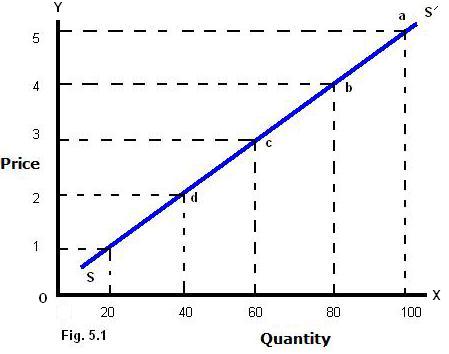
TABLE INDICATING THAT CHANGE IN DEMAND WITH RESPECTIVE OF CHANGE IN PRICE:
PRICE (Y -AXIS)
DEMAND (X-AXIS)
100
20
80
40
60
60
40
80
20
100

GRAPH INDICATING THAT CHANGE IN DEMAND WITH RESPECTIVE OF CHANGE IN PRICE:


ASSUMPTIONS:
  • ·         Habits, tastes remain constant
  • ·         Value of money & income of people will remain constant
  • ·         Price of substitutes will remain constant

EXEMPTIONS:
  • ·         Giffen goods (cheap goods) ex: vegetables , petrol  etc.,
  • ·          prestigious goods (costly goods) ex: I phone, branded cars etc.,
EXAMPLES:

    • ·         Amazon sale (when of price of the product decreases people buy           purchase in high quantity)
    • ·         Festival offers etc.,

    Brief of Price elasticity of supply

    • The price of elasticity of supply 
    *The law of supply states that higher prices raise the quantity supplied .
    The price elasticity of supply measures how much the quantity supplied respond to change in the price

    * If supply is elastic producer can increase their output without a wise in cost or sometime time also delay .

    * price of elasticity enable to producer to change in their amount of the good they produce

    * price of  elasticity of supply can be calculated as 

    %change in inequality supplied
    ___________________________________
    % change in price 
    So by this we can easliy calculated .

     * The main objective of price elasticity of supply *
    * If supplies have time to respond to a price change.

    * Generally supply of a good said to be elastic if the quantity supplied resopnds substantially to change in the price .

    * Supply is said to be in elastic if the quantity suppdlied respond only slightly to change in price .

    Gap between Willingness & Actual Pay

    Consumer Surplus :-

    The gap between the price what consumer willing to pay and what consumer actually pays is called consumer surplus.

    Dupit originated the concept of consumer's surplus.

    Consumer's surplus calculation :

    Consumer's surplus =  Price × Quantity
                                       OR
    CS = Price willing to pay – Actual price paid

    Advantages of consumer's surplus :
    1. Consumer surplus helps in taxation policy    
         and make it easy.
    2. It helps in welfare economics.
    3. Profit from International trade is measured   
        on the basis of consumer surplus.
    4. It is useful in determining the price policy 
        of a monopoly firm.
    5. It clarifies the contradiction of value.

    Producer Surplus :-

    Producer surplus is the price a firm receives for selling unit of a product minus the marginal cost of producing that unit.

    Producer Surplus Calculation :

    Producer surplus = Profit + Fixed cost
                                    OR
    Producer surplus = Total Revenue –
                                          (Total  cost – Fixed cost)

    Demand

    As demand increases price decreases from consumer side and from the supplier side demand decreases price increases.  Inverse relationship  between the price of a goods and quantity buyer are willing to purchase in defined time period.  But there is a exception in the inferior goods i.e price increases demand also increases for example gold,  air conditioner  etc.  As i mentioned above from the supplier side that with increase in price demand increases from supplier  side because supplier  wants to earn more and they increases the price.
    Non price determinants supply are as follows 
    Cost of production
    Profitability of alternative
    Profitability of goods in joint
    Nature of random shock
    Non price determinants of demand
    Taste buying cloth
    Number and price of suitable goods
    Number  and price of suitable goods
    Distribution of income
    Expectation
    All the above are the determinants of demand and supply which determine the buyer to buy a commodity and seller to sell the commodity.

    Calculating The Elasticity of Demand...

    Price elasticity of demand:-

    It is a measurement of change in quantity demand due to change in price of the commodity.It refers to the degree of responsiveness of quantity demand.Elasticity of demand measures the responsiveness of demand to change in price.
    Elasticity is a measure of how much buyers and sellers respond to changes in market conditions.In other word Elasticity is a measure of the responsiveness of quantity demanded or quantity supplied to a change in one of its determinants.


    Price in-elasticity of demand:-

    In in-elasticity of demand the change in price doesn't effect on the demand of the commodity.If the price changes up to 25% but the demand changes is 2% to 3%.Then as compare to the price change the demand change is negligible.so it's in-elasticity of demand.

    EXAMPLE-The price of SALT doesn't effect on market.Because people use salt in their day to day life,so the changes in price doesn't effect on the demand of people. 

                                                                                                                                        
                                                                    Image result for ed =0
                                                       source:(www.economicsdiscussion.net)  

    In the above diagram P1, P, P2 are the various price of a commodity.which is not effect on the demand of that commodity. SO ELASTICITY OF DEMAND (Ed=0)  


    The Equilibrium price of OLA Cab's

    The Equilibrium price of OLA Cab's

    Equilibrium Price: The point at which both the supply and demand curve intersect each other is called Equilibrium Price. It also states that the quantity demanded is equal to quantity supplied at the given equilibrium point.


    This can be explained briefly by taking OLA Cabs as an example of showing the relationship between Price, Demand, and Supply with the respective graph.

    Price 󠄃
    Demand
    Supply
    100
    50
    10
    200
    40
    20
    300
    30
    30
    400
    20
    40
    500
    10
    50

    The table shows about the Price, Demand, and Supply of OLA Cabs:
    1. There is an inverse relationship between the price and demand. when the price is increasing the demand for the cabs decreasing.
    2. There is a direct relationship between the price and supply. When the price is increasing the no of are increasing.
    3. We can see that the demand and the supply are equal when the price is Rs.300/- which is called the equilibrium price.
    Equilibrium Price Graph

    The above graph shows about the supply and demand curve, Equilibrium point, surplus and shortage of  demand and supply:

    1. At the equilibrium price we can see that the quantity demanded is equqal to quantity supplied at Rs.300/-
    2. At Rs.400/- we can see a surplus of supply, where the quantity demanded is 20 but the supply is 40.
    3. At Rs.200/- we can see a shortage of shortage of supply, where the quantity demanded is 40 but the supply is 20.  
    NOTE: There can be a change in the Equilibrium Price if there a shift in the demand or the supply curve.

    Consumer Surplus and Producer Surplus


    Consumer Surplus:

    Consumer surplus is basically defined as the difference between the price consumer is willing to pay and consumer actually pays for the goods and the services. It is defined as by the area under demand curve and above the market  price. When price decreases consumer surplus increase upto certain point.

    Producer Surplus:

    Producer surplus is defined as the difference between the price, which producer is willing to sell and the price actually sold by the producer. It is shown by the area above the supply curve and below the market price. When price decreases the producer surplus increases.

    Effect of price and income fluctuations on daily needs

    As perfectly defined by N. Gregory, elasticity is measured by how much buyers and sellers responds to the changes in market conditions.

    If we think of a situation, when the price of rice, wheat or pulses goes up. It's unlikely that the the demand of people especially in India who are habituated to a specific roti '' indian bread'' and rice in their meal. Hence these crops are inelastic. Though a slight decrease in demand doesn't effect the consumer's basic needs for the same. However, the rise in prices of a particular veggie will definitely see a drop in demand on basis of availability of substitute and moving towards elasticity or price elastic zone.
    Price and income are codependent on each other, as the income of a person determines his ability to buy or increase his demand from basics to luxurious needs as per Maslow's theory.
      Market researchers have always focused to increase revenue on elastic demands involving-
    - Lowering prices to increase quantity purchases.
    -Attracting customers via advertisements and endorsements.
    -increasing price on certain product, which increases revenue by good effective margins.

    As per my perception, income rise is proportional to rise in demand and vice versa.
    Also this study can be effective in forecasting and setting up the product in the market based on their(people's) economic statures.

    Simplified Grasp on Variety of Supply Curves

    Supply Curve simply is defined as the relationship between product price and quantity. Let's take an example to understand clearly. Imagine yourself as a seller and supply here refers to the number of goods that are available to you. People who are willing to buy your goods refers to demand. Now when people buy your goods more result in the increase of supply hence the price of a product goes down and vice versa. Remember that supply sometimes increases because product cost less and this justifies only for limited period of time. What if small price fall leads to shrinkage in supply? This is what we term this situation as the elasticity of supply. In a real-life scenario, the elasticity of supply is not constant but it varies among supply curves.

    Graphical representation of the Price elasticity supply is explained below:-
    (a) Perfectly Inelastic Supply
    Elasticity is equal to zero. Suppose being a seller your products price changed frequently due to any reasons but quantity supplied remained unaffected.

    (b) Inelastic Supply
    Elasticity is less than 1. Suppose the price of an item reduced to Rs.30 from its previous rate Rs.40 and supply reduces from 16% to 15% i.e. 1%. This supply is said to be inelastic.

    (c) Unit Elastic Supply
    Elasticity is equal to 1. When the quantity of supply changes with respect to changes in price.

    (d) Elastic Supply
    Elasticity is greater than 1. If big changes are observed in quantity supply when minor changes in price.

    (e) Perfectly Elastic Supply
    Elasticity equals infinity. Even a minute fall in the price of a product cause the supply immediately fall to zero.

    CONSUMER SURPLUS AND PRODUCER SURPLUS


       CONSUMER SURPLUS

             
           It is the difference between the price that a buyer is willing to pay and the buyer is actually pays.
                                  
     Example                     
                       There are three persons who wants to buy painting in an auction. Each of them are looking to buy that painting. Each one have to limit according to their budget. Below table shows that maximum price that each of them pays. That maximum amount of each buyer is called willingness to pay. Each buyer is eager to pay the painting at a price  less than their actual pay.
                                                     
                                                       BUYER          WILLING TO PAY
                                                        person A        500$
                                                        person B         300$
                                                        person C         200$
    As the person A  stops the bid at 350$ and another two persons are unwilling to do bid further. person A got the painting .Here the point is that he is willing to pay 500$ but he actually pays the amount is 350$. Person A receives consumer surplus of amount 150$.

       PRODUCER SURPLUS
     

                                   It is the  difference between the price that a producer is willing to sell and the price actually sold. the surplus amount is the benefit that producer receives for selling the good.

      Example
                               
                   A producer is willing to sell 100 apples each of price 2$ and consumer is willing to purchase it at 3$. If the producer sells the apples at a price of 3$, receives an amount of 300$. 300$-200$=100$. Here the producer got a surplus amount of 100$.   


    Price Elasticity and the Factors Affecting it

    PRICE ELASTICITY

    Price elasticity is what we measure the consumers reaction to the change in price of the products.

    Price Elasticity = %change in quantity / %change in price

    Price Zone:

         Here we are categorizing the pricing of the product according to changes in price. 
    If the price on our favorite brand like foods and beverages changes then we can switch brands or can reduce the consumption of the product. But, if an item is of absolute need which can't be replaced then wee have to curtail our use so far. Therefore there are zones of the price elasticity that will help us determine where our product falls.

    1. Perfectly Elastic: Here a small changes in the price results a huge change in demand of the products. this zone is home to that product which consumer view as expendables.
    2. Relatively Elastic: A small change in price causes significant  changes in demand. Here consumer will see for alternate products to fulfill there needs.
    3. Relatively In-elastic: Here change in price cause small changes in demand because people are not willing or able to reduce their consumption.
    4. Perfectly In-elastic: These are things that consumer needs and are forced to pay the set price to obtain the product.
    Example: If you are having a single cable operator in your area then you are forced to pay the amount set by the provider to have access to the product used for daily need.

    Price Elasticity Benefits:

    It is used to find the price point of maximum profitability. The point where the increase in price margin are offset by lower demand and sales. This ideal price can be compared with current pricing to see what kind of product are under or over priced.
    Calculating the max profit and other pricing strategies guidance for production team and data analytics to work alongside for better alignment of pricing to the current market to identify changes and to optimize product at a segment or location level.


    Relationship between price , goods , Consumer and producer.

    Our last class was all about so many different topics . We learn about Revenue , Pricing and Elasticity as
    1. If goods are elastic
    ~then reduce price to increase revenue
    2.If goods are inelastic
    ~then increase price to increase revenue
    3. Unitary elastic
    ~then hold price constant , no effect on revenues .

    Then we learn , The Price Mechanismin which there are Goods Market and Factor Market .
    Pes = /Ped/
    Pes < /Ped/   : divergence
    Pes > /Ped/   : convergence
    Where Pes = Price elasticity of sales and
                 Ped = Price elasticity of demand
    Then , Consumer Surplus : this is the difference between the price which the consumer is willing to pay and what consumer actually pays .  And.
              Product Surplus : this is the difference between the price which producer is willing to sell and at what price actually sold .
    Now the next we learn was how to draw graph or can say how to draw line on graph .
    At last we learn about consumer / producer behaviour .Here it explains about production , usage and deposition of goods , services , activities and ideas in a given time period . 

    Elasticity and it's Nature


    Elasticity

    Elasticity is to measure, how much the quantity is demanded for a good with respect to its price, income and supply. It can also be known as the measure of responsiveness of quantity demanded or quantity supplied to change in its determinants. Elasticity determines the fundamental relationship between price and demand for a good/service.
    If for a product quantity demanded changes a lot when price is changed a little is called as Elastic. If the price changed a lot and demand does not change much is called Inelastic.

    Examples

    If the price of the petrol increases the demand still is the same because for people driving and going to their respective places is important. There are substitutes like train and walking but the usage can’t be regular. It is Inelastic in nature.
    Consider two vendors are selling a bag of chips. If one seller has high price and the other has low price. People buy the product at low price vendor. So, it is Elastic in demand.

    What is Consumer Behavior?

    Consumer is one who consumes goods and services available in the market. Consumer behavior is defined as the behavior that consumer display in searching for purchasing, using, evaluating and disposing of product and services that they expect will satisfy their needs. Consumer behavior focuses on how individuals make decisions to spend their available resources (time, money, effort) on consumption related items. This includes what they buy, why they buy it, when they buy it, where they buy it, how often they buy it, how often they use it, how they evaluate it after the purchase and the impact of such evaluation on future, and how they dispose of it.

    INELASTIC GOODS

    Inelastic goods are those which leads to increase in revenue after increasing price. I.e. When price Rises  than their demand did not fall  or fall to a very little extent. For example if increase in price of petrol is 40% than decrease  in consumption of Peteol will only be 5%, this leads to increase in the overall revenue.
               The most famous example of inelastic demand is that  for petrol. As the price of petrol increases the quantity demand do not decreases to that much extent. It is because there is no or few substitute for petrol available. Therefore consumers are still willing to buy it even at relatively higher prices.
                   Price elasticity can be generally seen in the goods or services which have no alternatives, for example only Atif Aslam can offer a Atif Aslam concert. He holds the power on the creation and delivery of that experience there is no alternative or substitute, therefore fans are willing to pay for the experience because the delivery is controlled by single person. People are left with no alternative so even at Higher prices people buy the same or higher number of tickets.
            Thus above were the examples of inelastic goods and an effort was made to make everyone understand the concept of inelastic goods.

    The price elasticity of demand

    Price elasticity of demand:-
    It measures how much the quantity demanded of good changes when its price changes.
                                     Ed= % change in quantity demanded
                                                 % change in price

    • when the price elasticity of good is high, then the good has ‘elastic’ demand.
                 -Qunatity demanded respond highly when price changes.

    • when the  price elasticity of good is low, then the good has ‘inelastic’ demand.
                 - Quantity demand respond little when price changes.

    Examples:-
    • when the price of some neccessities item (like food, clothes, shoe, prescription drugs) rises, then the demand tend to be ‘inelastic’.

    •on the other hand when price of luxury goods (like designer clothes) or substitute goods ( like price of tea rises then people will shift to coffee), rises then the demand tend to be ‘elastic’.

    The price elasticity of demand fall under 3 categories:-

    1.Elastic demand:-
    If 1% increase in price then there will be 5% decrease in quantity demanded.

    2.unit elastic demand:-
    If 1% increase in price then there will be 1% decrease in quantity demanded.

    3.price inelastic demand:-
    If 1% increase in price then tere will be 0.2% decrease in quantity demanded.


    Thursday, July 26, 2018

    Pricing Decisions

    Consumer Surplus:
    Difference between the price consumer is willing to pay and consumer actually pays
    Example: Bargain on shirt
    The price of a shirt is 1000 rupees, consumer ask the same shirt price as 400rupees, but actually consumer purchased 550 rupees, and consumer willing to pay is 750 rupees.
                      750-------willing to pay
                      550-------Purchase rate
                      200-------Consumer surplus
    Producer Surplus:
    Difference between the price producer is willing to sell and the price actually sold
    Example:
    my selling price of saree is 1000rupees, i told the customer the saree price is 1500rupees,and i sold the saree at 1200 rupees.
                         1000-----Willing to sell
                         1200-----Actually sold
                          200-----Producer surplus.


    Wednesday, July 25, 2018

    ABOUT ELASTICITY

    ELASTICITY:
                           It is a measure of how much the quantity is demanded of a good and how much the changes in relation to price of the product.That is , Income or Supply.
                In simple words,
    Changes in one variable due to the changes in another variable ,called ELASTICITY.
    In elasticity their are two types of work take place .That is,
    -ELASTIC
    -INELASTIC
    ELASTIC - If the demand of product changes lot, when price changes little, a product is said to be elastic.
    For example- In summer,the price of ice cream changes little and the demand of ice cream changes lot, this type of example is said to be elastic.
    INELASTIC - If the demand of product changes little, when price changes lot,a product is said to be inelastic.
    For example - If their is a lack of sugar   production, the ice cream company will afford more price to purchase sugar for preparing ice cream which makes to increase the price of ice cream more. But in summer the demand of ice cream changes little. This type of example is said to be inelastic.
                

    Saturday, July 21, 2018

    Law of demand

    Law of demand states that other factors being constant, price and quantity demand of any good and service are inversely related to each other. When the price of a product increases, the demand for the same product will fall.
    For example,a consumer may demand 2 kgs of salt at Rs 50 per kg; he may however demand 1kg, if the price rises to 60 per kg.
    This is general human behaviour on relationship between the price of the commodity and quantity demanded.The factors held constant refers to other determinants of demand.

    DEMAND & ELASTICITY OF DEMAND

    Meaning of Demand : 


    The concept of demand refers to the quantity of a good or service that consumers are willing and able to purchase at various prices during a given period of time.Demand in economics, is something more than the desire to purchase, though desire is one element of it.A beggar, for instance may desire food but due to lack of means to purchase it, his demand is not effective.Effective demand for a thing depends on

    (i) Desire
    (ii) Means to purchase &
    (iii) Willingness to use those means for that purchase.

    Two things are to be noted about the quantity demanded:

    1.The quantity demanded is always expressed at a given price. At different prices different quantities of a commodity are generally demanded.

    2. The quantity demanded is a flow. We are concerned not with a single isolated purchase, but with a continuous flow of purchases and we must therefore express demand.

    DETERMINANTS OF A DEMAND :-


    There are number of factors which influence demand for a commodity.All these factors are not equally important.Some of these factors cannot be easily measured or quantified. The important factors that determine demand are as follows :

    (i) Price of the commodity
    (ii) Price of related commodities
    (iii) Income of the consumer
    (iv) Tastes and preferences of consumers
    (v) Consumer's Expectations
       
       Other factors :
                (a) Size of population
                (b)Composition of population
                 (c) The level of national income and its distribution
                 (d) Consumer-credit facility and interest rates

    ELASTICITY OF DEMAND :


    Elasticity of demand is defined as the responsiveness of the quantity demanded of a good to change in one of the variables on which demand depends.Elasticity of demand is the percentage change in quantity demanded divided by the percentage change in one of the variables on which demand depends.

    (i) Price Elasticity
    (ii) Point  Elasticity
    (iii)Arc Elasticity

    (1)Income Elasticity of demand
    (2) Cross  Elasticity of demand
            (a) price of related goods and demand,
            (b) Substitute products&
            (c) Complementary Goods
    (3) Advertisement Elasticity of demand.